
Your Body Isn’t Tight for No Reason: What Chronic Muscle Tension Is Trying to Tell You
You stretch.
You rub the spot.
Maybe you use a heating pad, take a hot shower, roll around on a massage ball, or finally schedule a massage.
It feels better.
And then a few days later…
There it is again.
That same knot between your shoulder blades. The neck that never seems to completely loosen. The low back that starts complaining every afternoon. The shoulders that somehow end up practically touching your ears by the end of the workday.
If this sounds familiar, here is something I want you to understand:
Your body probably isn’t getting tight for no reason.
Tension is often the result of something your body has been repeatedly experiencing: how you move, how you sit, what you do for work, an old injury, repetitive activity, weakness or compensation, stress, or sometimes a combination of several things.
The question shouldn't always be:
“Where does it hurt?”
Sometimes the better question is:
“Why does this area keep having to work so hard?”
Tight Muscles Aren’t Always the Whole Problem
When something hurts, our natural reaction is to focus on that exact spot.
Your neck hurts, so the neck must be the problem.
Your low back hurts, so something must be wrong with your low back.
There is a giant knot in your shoulder, so somebody needs to attack that knot until it finally gives up.
Except the human body doesn't work as a collection of completely separate parts.
Muscles work together to stabilize and move your body. When one area isn't doing its job efficiently, another area may have to work harder.
Over time, the area doing the extra work may become the one screaming for attention.
That means where you feel the problem isn't necessarily where the problem started.
This is also why simply working harder and harder on the painful spot doesn't always create lasting change.
Your Daily Habits Add Up
Most people don't injure themselves dramatically while sitting at their desk.
They don't hear a giant POP while answering an email and suddenly develop chronic shoulder tension.
Instead, it can build gradually.
Think about what your body experiences during an average day.
Maybe you:
Spend hours looking down at a phone.
Work at a computer with your head slightly forward.
Drive for long periods.
Carry a child on the same hip.
Stand primarily on one leg.
Perform the same movements repeatedly at work.
Sleep in the same position every night.
Exercise intensely on the weekend after sitting most of the week.
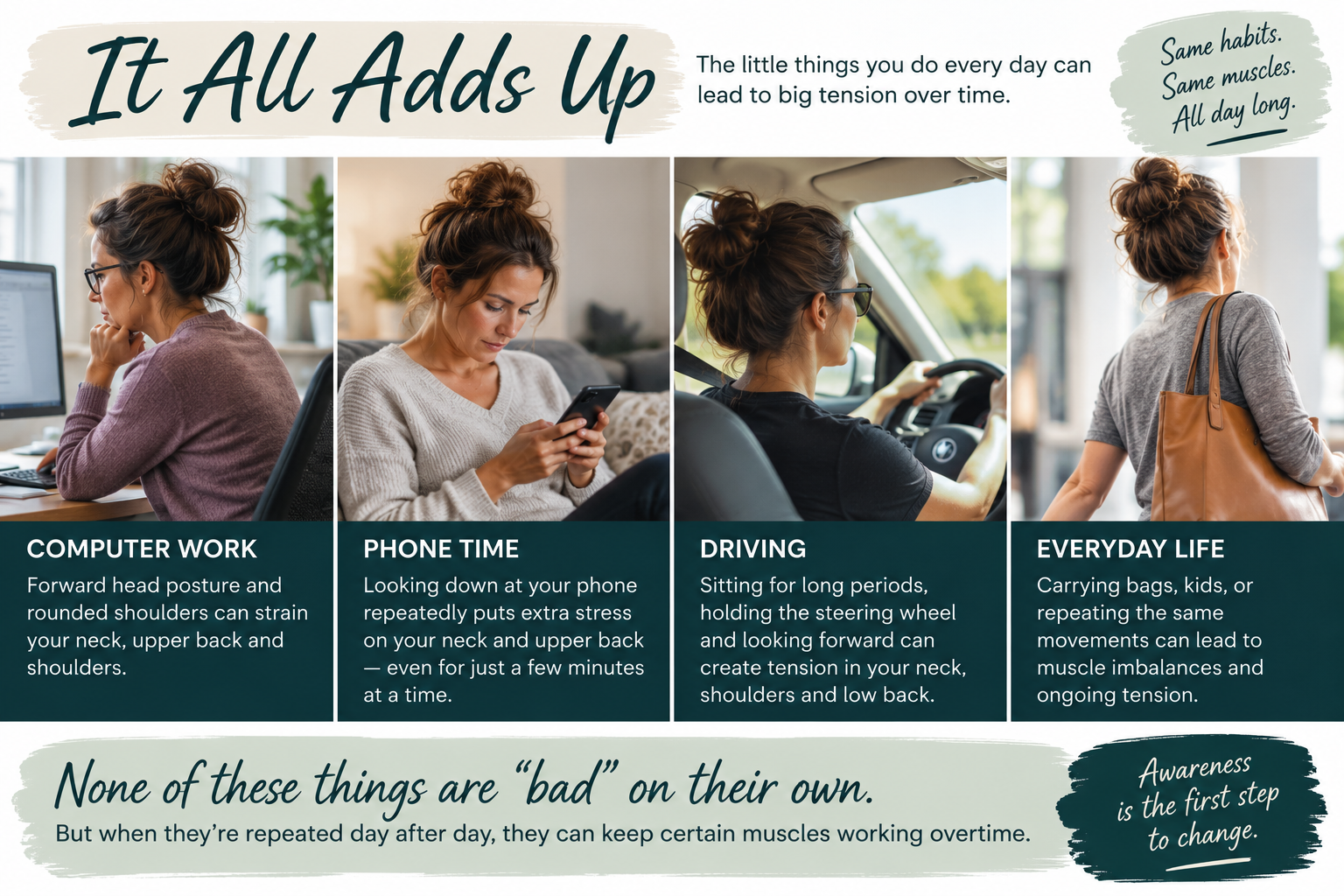
None of those things automatically means something is wrong.
But repeated positions and movements can place ongoing demands on certain muscles.
According to the Mayo Clinic's overview of myofascial pain syndrome, repetitive muscle movements, poor posture, muscle injury and stress-related muscle tension can contribute to the development of sensitive areas known as trigger points.
Your body is incredibly good at adapting.
Sometimes the tension you're feeling is part of that adaptation.
Stress Doesn't Stay Only in Your Head
This is one people underestimate.
Think about what happens when you're stressed.
Do your shoulders rise?
Does your jaw tighten?
Do you clench your teeth?
Do you notice yourself holding your breath?
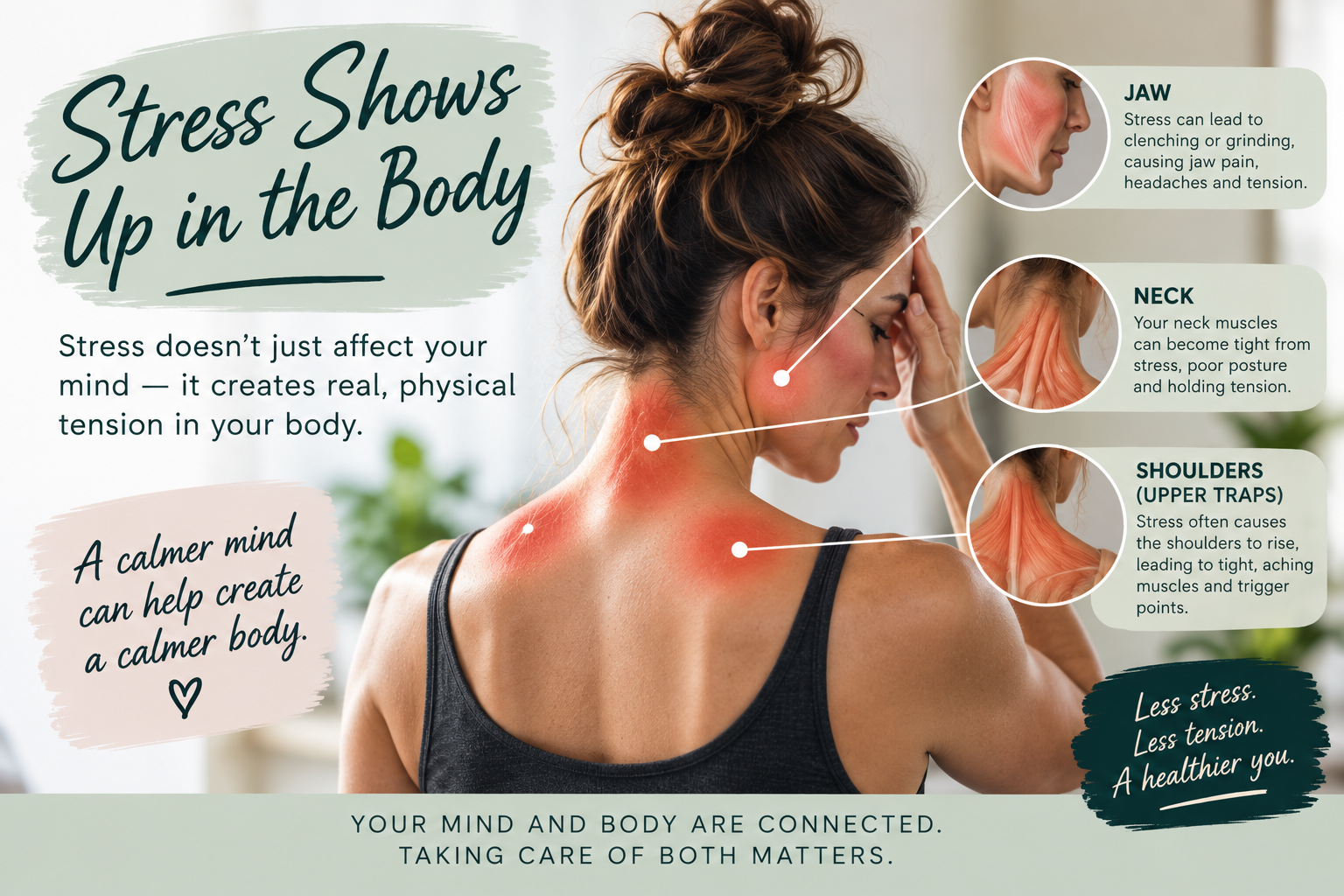
Stress can have very real physical effects. The Cleveland Clinic's information on stress lists physical effects that can include muscle tension, jaw clenching, headaches and problems sleeping.
And if your body spends significant amounts of time in that state, those patterns can become very familiar.
This doesn't mean your pain is “all in your head.”
Quite the opposite.
Your nervous system, muscles, sleep, emotions and pain experience are interconnected. The National Institute of Neurological Disorders and Stroke's information about pain explains that chronic pain has a two-way relationship with mood, emotions, mental health and sleep.
In other words, pain can affect these areas — and these factors can also influence how we experience pain.
That's one reason addressing persistent tension sometimes requires looking beyond the muscle itself.
Then There Are Compensation Patterns
This is where corrective work gets interesting.
Imagine you hurt your right ankle.
For a while, you shift your weight to the left.
Your body is doing exactly what it should do — protecting the injured area so you can continue moving.
Eventually the ankle feels better.
But what if your movement pattern never completely returns to normal?
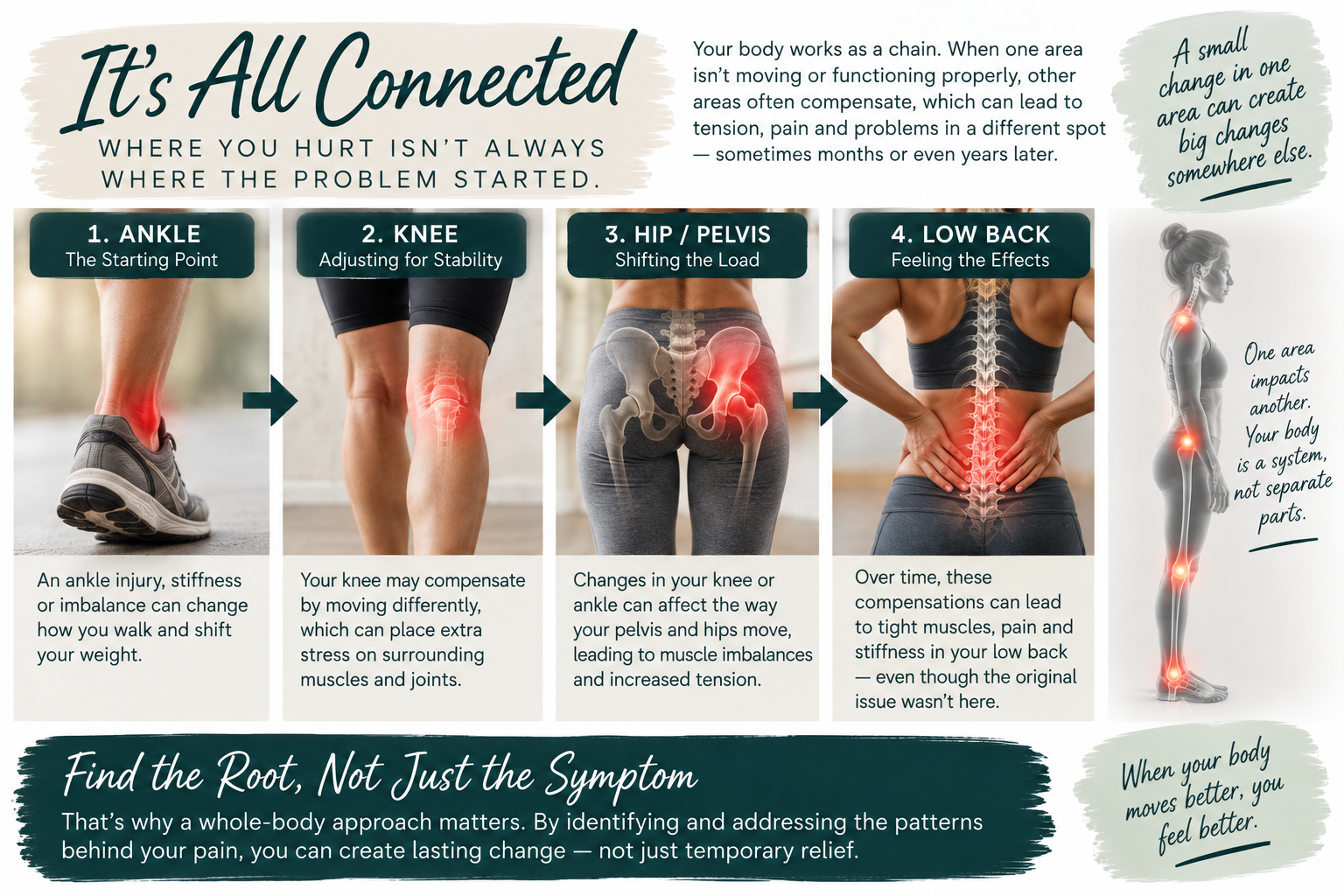
Now your hip may move differently.
Your pelvis may compensate.
Your back may start working differently.
And months later you're saying:
“I don't understand why my back hurts. I didn't do anything to my back.”
Exactly.
The back may not have been where the story started.
Old injuries, repetitive movement patterns and muscular imbalances can change how your body distributes work. Sometimes the painful area is simply the place that finally says:
“I can't keep doing everybody else's job.”
Why Does the Knot Keep Coming Back?
This is one of the most common frustrations I hear.
“I get this same knot all the time.”
If we release an area but immediately return the body to the same demands that created or contributed to the tension, it makes sense that the tightness may return.
That's why lasting improvement may involve more than repeatedly chasing one knot.
Depending on what is contributing to the problem, the bigger picture might include:
Manual therapy
Improving mobility
Strengthening weak or underused areas
Changing repetitive movement patterns
Improving workstation ergonomics
Taking movement breaks
Managing stress
Improving sleep
Addressing an injury
Working with another healthcare professional when appropriate
There isn't one universal answer because there isn't one universal reason people hurt.
For example, the Cleveland Clinic's guide to muscle stiffness discusses several potential causes of stiffness and when persistent symptoms warrant medical evaluation.
This Is Why We Look Beyond Where It Hurts
At Phoenix Body & Mind, corrective massage isn't about finding the most painful spot and beating it into submission.
We want to understand the pattern.
Where are you restricted?
What movements aggravate the problem?
What does your job require your body to do every day?
What old injuries have you had?
Where are you compensating?
What areas are working overtime?
And most importantly:
What keeps bringing you back to the same problem?
Sometimes the painful muscle absolutely needs attention.
But sometimes that muscle is the exhausted employee doing three people's jobs.
If we only yell at the exhausted employee, we haven't fixed the workplace.
Start Listening Before Your Body Has to Yell
Your body communicates with you constantly.
Tightness.
Stiffness.
A recurring knot.
A headache after certain activities.
That ache that appears at approximately the same time every day.
Limited movement.
Those can all be pieces of information.
Pain shouldn't automatically be ignored, normalized or simply pushed through.
Persistent or unexplained pain should be evaluated appropriately by a healthcare professional, especially when it is severe, worsening or accompanied by other concerning symptoms.
But for many everyday musculoskeletal problems, becoming curious about the pattern can be incredibly valuable.
Instead of only asking:
“How do I make this stop hurting?”
Start asking:
“What keeps making my body come back here?”
Because your body isn't necessarily fighting you.
It may have been adapting to what you've asked it to do.
And sometimes the first step toward changing the pattern is finally understanding why the pattern exists.
Ready to Find Out What Your Body Has Been Trying to Tell You?
If you keep dealing with the same neck tension, shoulder knots, back pain or muscular tightness, let's stop chasing the symptom and start looking at the bigger picture.
At Phoenix Body & Mind, our corrective approach is designed to look beyond where you hurt and explore the patterns that may be contributing to why the problem keeps returning.
The body doesn't lie, but we can teach it a new truth.
Schedule your session with Phoenix Body & Mind and let's start figuring out what your body has been trying to tell you.
References
Medical disclaimer: This article is for general educational purposes and is not intended to diagnose or treat a medical condition. Persistent, severe, unexplained or worsening pain should be evaluated by an appropriate healthcare professional.
