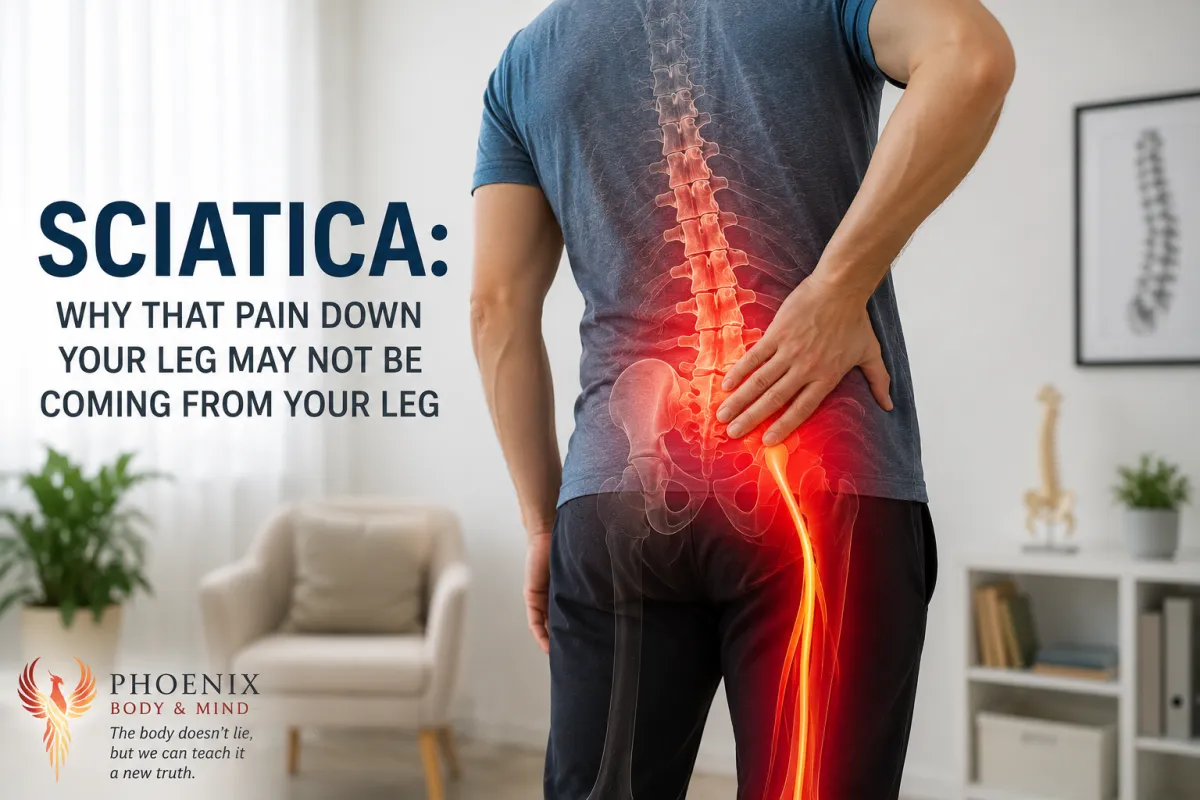
Sciatica: Why That Pain Down Your Leg May Not Be Coming From Your Leg
That burning pain running down your leg.
The ache deep in your hip or buttock.
The tingling, numbness, or strange sensation that seems to travel from your lower back toward your foot.
If you've experienced symptoms like these, you've probably heard one word:
Sciatica.
But here's something important to understand:
Sciatica describes a pattern of nerve-related symptoms. Understanding what is causing those symptoms is an important part of determining the right care.
And not every pain that travels down the leg is necessarily true sciatica.
What Is Sciatica?
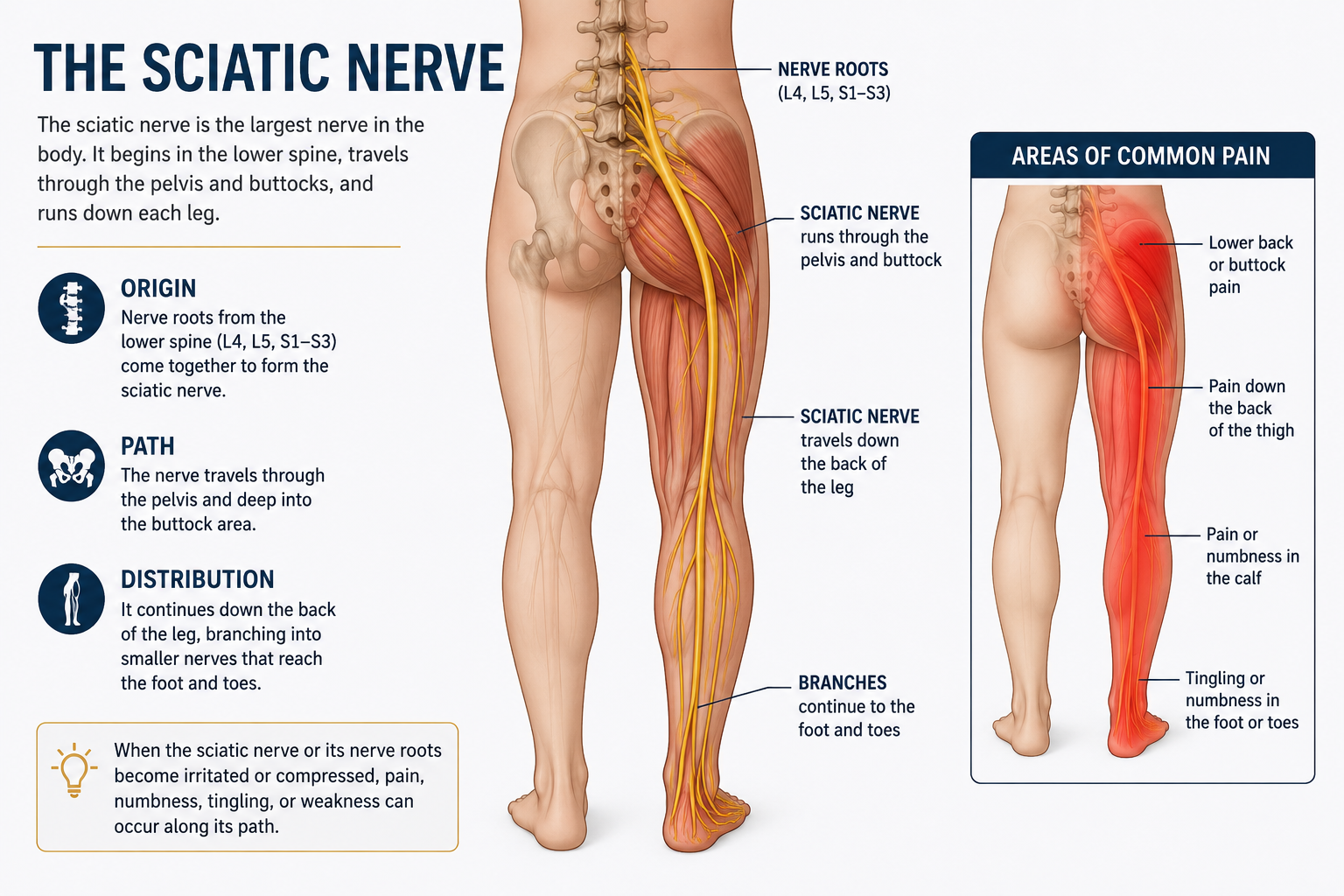
The sciatic nerve is the largest nerve in the body. It is formed from nerve roots in the lower spine and travels through the buttock and down the leg.
Sciatica occurs when the sciatic nerve or, more commonly, the nerve roots that contribute to it become irritated or compressed. Common causes include a herniated disc, spinal stenosis, bone spurs and other conditions affecting the lower spine.
Mayo Clinic — Sciatica: Symptoms and Causes
Symptoms may include:
Pain in the lower back, buttock or leg
Burning, shooting or electric-shock-like pain
Tingling or pins-and-needles sensations
Numbness
Muscle weakness
Symptoms that travel down one side of the body
The exact symptoms depend on which nerves and structures are involved.
Your Leg May Be Where You Feel It—But Not Where the Problem Started
This is one of the most confusing things about sciatica.
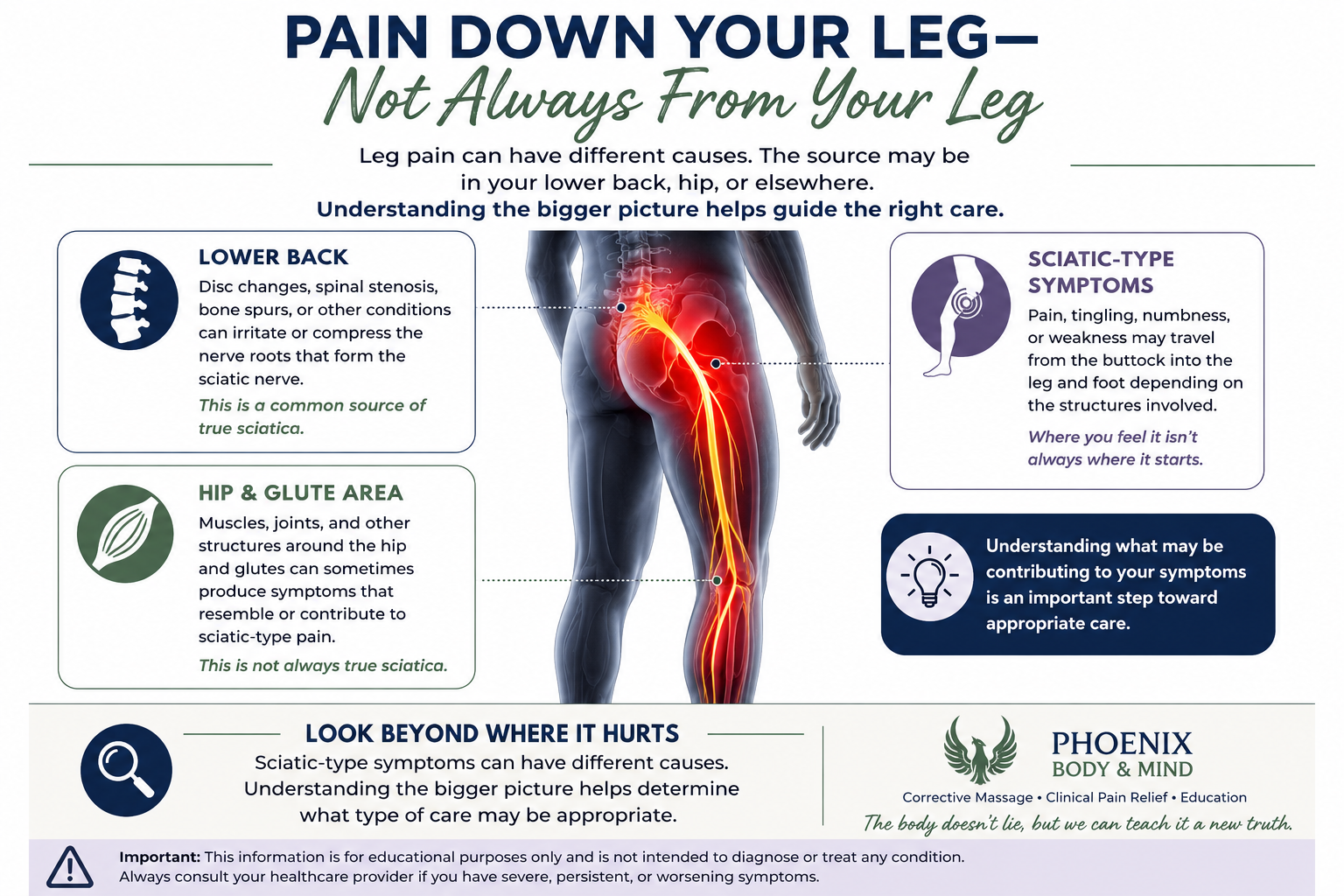
You may feel pain in your thigh, calf or even your foot, while the nerve irritation responsible for true sciatica originates much higher—often around the nerve roots in the lower spine.
That's why focusing only on the place where you feel pain doesn't necessarily tell you what is causing it.
But there's another piece to the puzzle.
Sometimes "Sciatica" Isn't Actually Sciatica
Not every pain that travels from the hip or buttock down the leg is caused by the sciatic nerve.
Cleveland Clinic distinguishes between true sciatica and sciatica-like conditions—conditions that can produce similar symptoms but have another underlying cause.
Muscles, joints and other structures around the lower back, pelvis and hips can also contribute to pain patterns that may feel similar to sciatica.
That's an important distinction.
If we automatically assume every pain traveling down the leg is "a tight piriformis" or true sciatica, we may be treating the wrong problem.
Where you feel pain gives us information. It doesn't always give us the entire answer.
Why Does It Keep Coming Back?
This is a question we hear often:
“It felt better for a while. Why did it come back?”
There isn't one answer that applies to everyone.
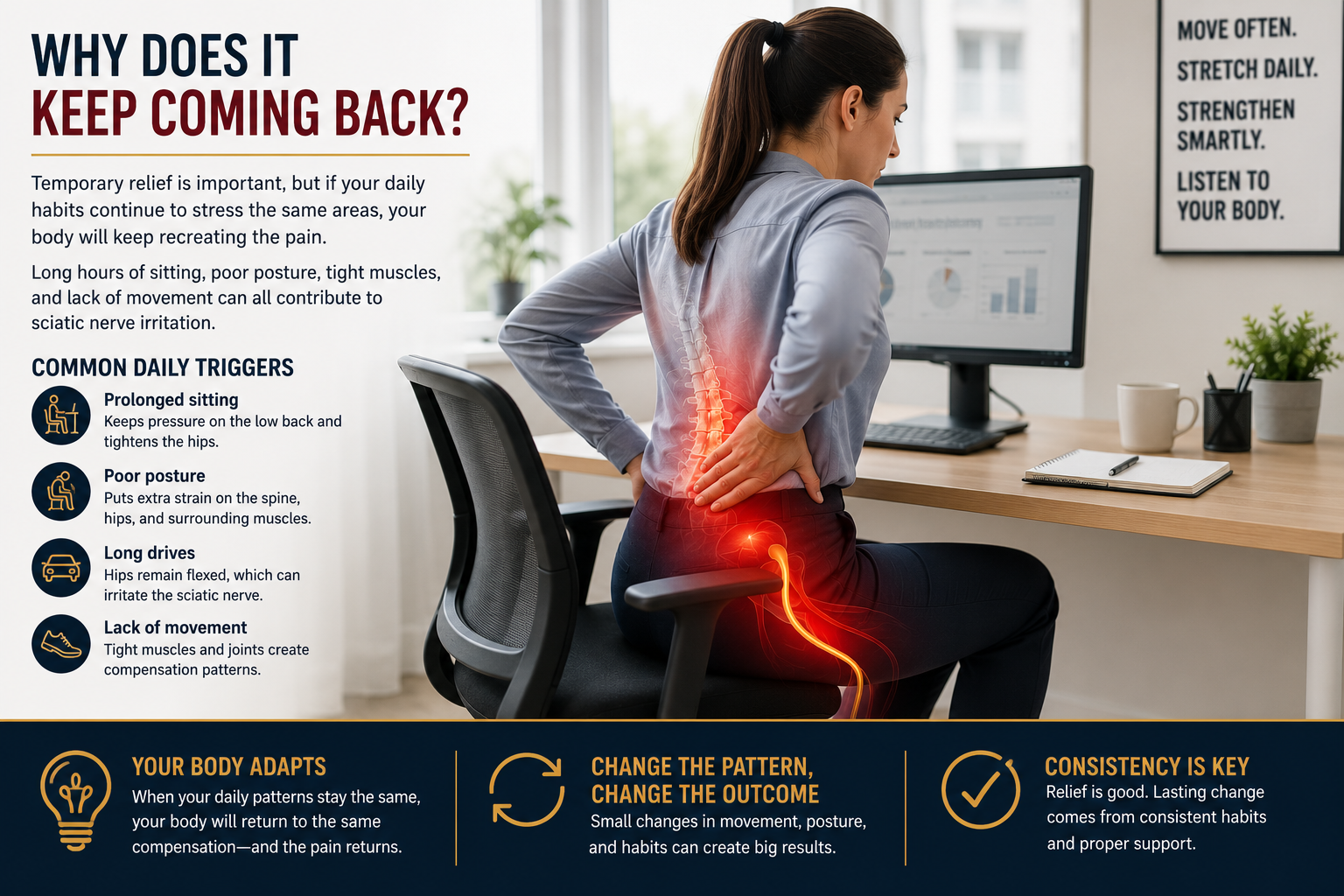
Your daily activities can affect your lower back and the way your body moves. Prolonged sitting, frequent bending, heavy lifting, driving for long periods and poor body mechanics are among the factors associated with back problems and sciatica.
That doesn't mean sitting at your desk automatically caused your sciatica.
It means your everyday movement and activity patterns are worth considering as part of the bigger picture.
Maybe you sit for eight hours a day.
Maybe you drive for long periods.
Maybe you've changed how you walk because another part of your body hurts.
Maybe you've become less active because movement has become uncomfortable.
The body adapts to what we repeatedly ask it to do.
So while a treatment session may temporarily decrease muscular tension or pain, returning to the same physical demands may contribute to symptoms returning.
Relieving pain and understanding why it keeps returning are two different goals.
What We Look At During Corrective Therapy
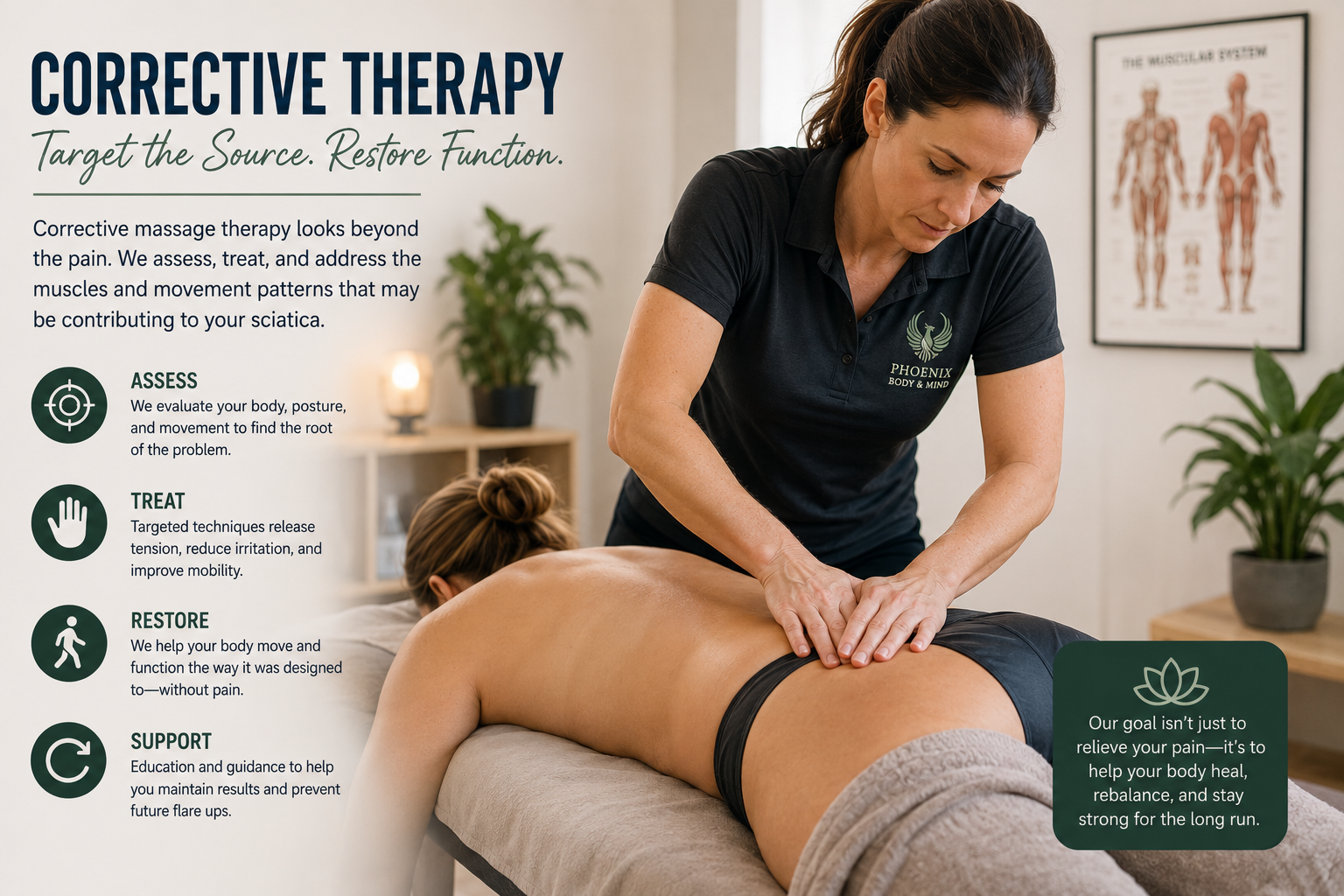
When someone comes to Phoenix Body & Mind with lower-back, hip, or sciatic-type symptoms, we don't assume we already know the cause.
We look at the person in front of us.
Depending on what we find, we may look at:
Areas of muscular tension
Hip movement
Gluteal muscles
Hamstrings
Hip flexors
Lower-back musculature
Differences between one side of the body and the other
Everyday sitting and movement habits
Repetitive activities
Previous injuries
Areas that may be compensating for restrictions elsewhere
Our job as massage therapists isn't to diagnose a herniated disc, spinal stenosis, or neurological condition.
Our job is to work within our scope, recognize the muscular and movement-related factors we can address, and recognize when someone's symptoms need evaluation by another healthcare professional.
Where Massage and Corrective Therapy May Help
Massage therapy isn't a cure for sciatica.
It cannot remove a herniated disc, reverse spinal stenosis, or correct every condition that can irritate or compress a nerve.
That's an important distinction.
However, massage therapy may help some people with low-back pain and associated muscular tension. Research suggests that massage may provide short-term improvements in low-back pain for some people, although the overall quality of the evidence is limited.
That's why our approach isn't:
“You have sciatica. Let's massage your sciatic nerve.”
Instead, we ask:
What muscular tension, movement restrictions, or compensation patterns are present that fall within what massage and corrective therapy can appropriately address?
For some people, targeted massage and movement work may be one useful part of a larger care plan.
For others, medical evaluation, physical therapy, or another form of treatment may need to come first.
When Massage Isn't the Right First Step
This is just as important as knowing when massage may help.
Certain symptoms shouldn't simply be treated as muscular pain.
Seek prompt medical care if sciatic-type symptoms are accompanied by:
Sudden or significant leg weakness
Sudden numbness or major loss of sensation
Loss of bowel or bladder control
Severe symptoms following significant trauma, such as a car accident
Symptoms that are severe, rapidly worsening, or otherwise concerning
Mayo Clinic specifically recommends immediate medical care for sudden leg numbness or weakness, bowel or bladder control problems, or sciatic pain following a violent injury.
Knowing when not to massage something is just as important as knowing when massage may help.
Stop Chasing the Pain. Start Understanding the Pattern.
If pain keeps traveling into your hip or leg, don't assume the painful spot automatically tells you what is causing it.
Sometimes true sciatica originates from irritation or compression of nerve roots in the lower spine.
Sometimes another condition can create symptoms that feel similar.
And sometimes muscular tension and movement patterns may be part of the overall picture.
That's why at Phoenix Body & Mind, we don't want to simply chase the place that hurts.
We look at the bigger picture, work with what falls within our scope, and refer out when your symptoms suggest that another type of care is needed.
Because feeling better matters.
But understanding what your body may be telling you matters too.
Ready to Take a Closer Look at Your Pain?
If you've been dealing with recurring lower-back, hip, or sciatic-type pain, schedule a session with Phoenix Body & Mind.
We'll look beyond the painful spot and assess the muscular and movement patterns that may be contributing to what you're experiencing.
Phoenix Body & Mind
The body doesn't lie, but we can teach it a new truth.
References & Further Reading
Mayo Clinic — Sciatica: Symptoms and Causes
Overview of sciatica, symptoms, causes, risk factors, and signs that require medical attention.
Mayo Clinic: Sciatica — Symptoms and Causes
Cleveland Clinic — Sciatica
Medical overview of sciatic nerve pain, including radiating pain, numbness, tingling, and possible causes.
Cleveland Clinic: Sciatica
National Center for Complementary and Integrative Health (NCCIH) — Low-Back Pain and Complementary Health Approaches
Review of current evidence regarding massage therapy and other complementary approaches for low-back pain.
NCCIH: Low-Back Pain and Complementary Health Approaches
