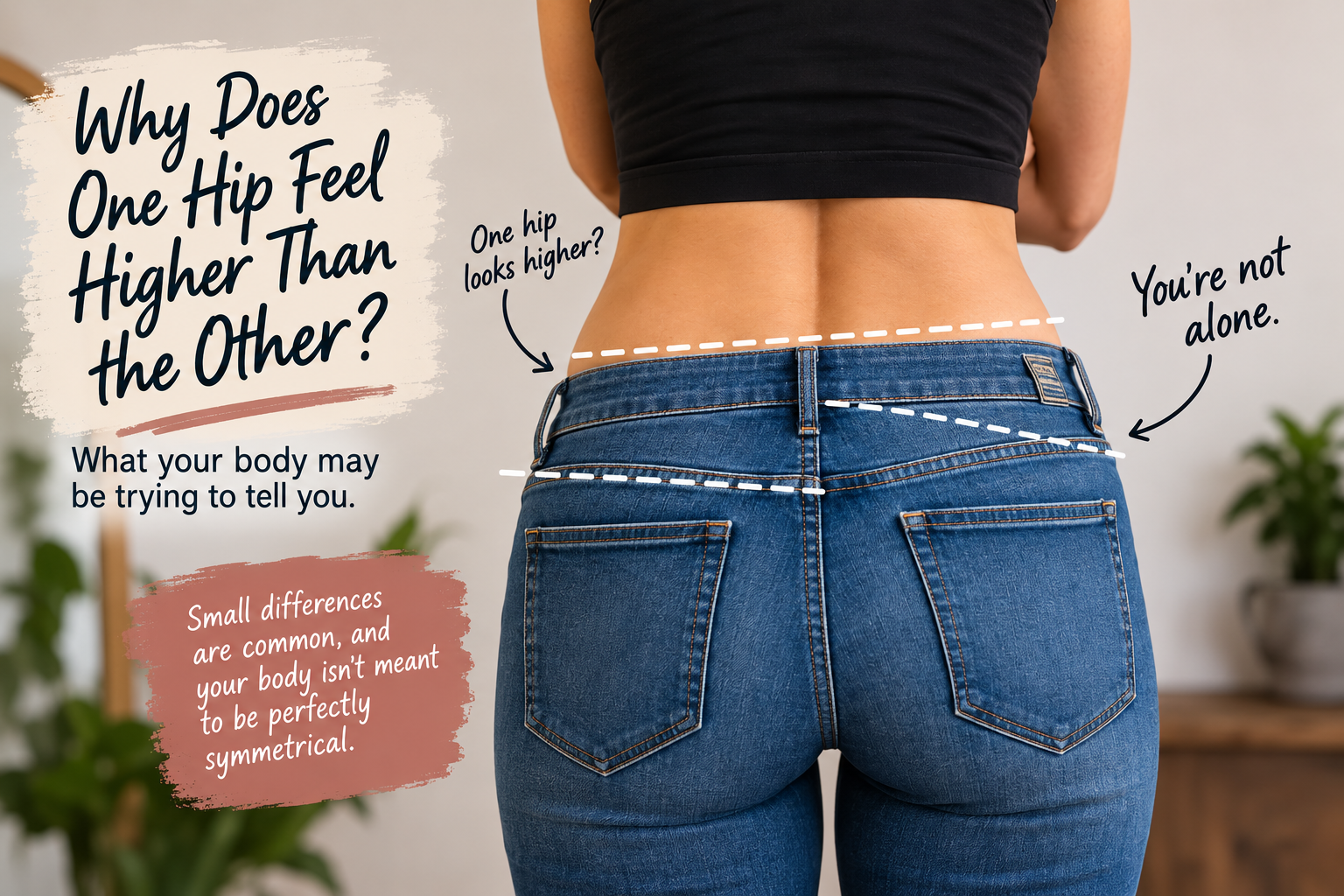
Why Does One Hip Feel Higher Than the Other? What Your Body May Be Trying to Tell You
Have you ever stood in front of a mirror and thought:
Wait. Is one of my hips higher than the other?
Maybe one side of your waistband always seems to sit differently. Maybe you constantly shift your weight onto the same leg. Maybe one side of your low back is always tight, one hip feels restricted, or you swear one leg feels longer than the other.
First, don't panic.
Your body isn't supposed to be perfectly symmetrical.
And noticing that one hip looks or feels higher doesn't automatically mean your pelvis is "out," one leg is shorter, or something needs to be shoved back into place.
But sometimes that uneven feeling can tell us something about how your body is moving, adapting, and distributing its workload.
And that's where things get interesting.
Your Body Is Not a Perfectly Symmetrical Machine
Most of us have differences from one side of our bodies to the other.
Research has found that small differences in anatomical leg length are extremely common and often aren't clinically significant. There is also a difference between a true structural leg-length difference and a functional or apparent difference created by how the body is positioned. Research discussing structural and functional leg-length differences can be found here.
So if somebody takes one look at you and announces:
"That leg is shorter."
Not so fast.
What looks uneven from the outside doesn't necessarily tell us exactly what's happening underneath.

Sometimes It's About How You Use Your Body
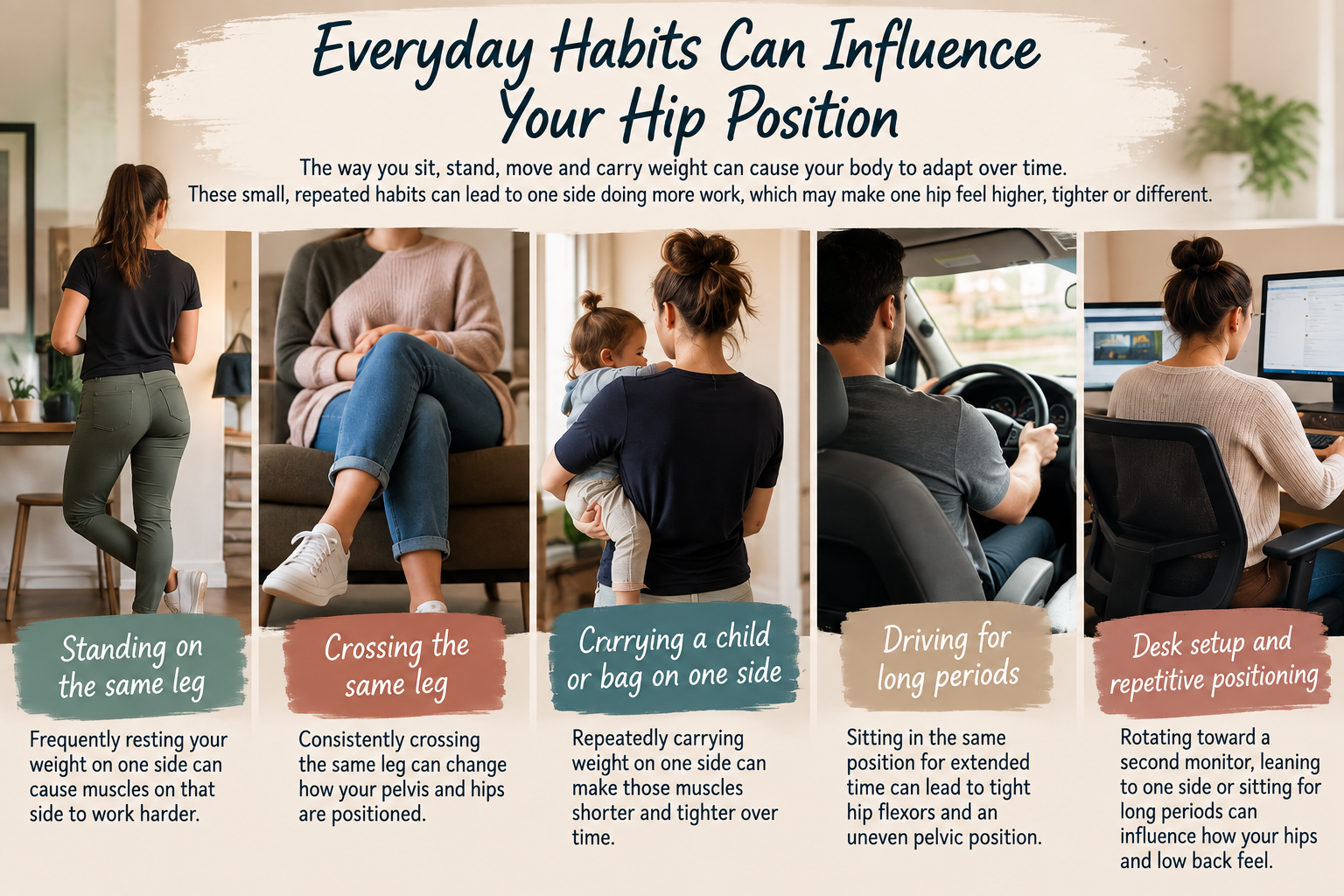
Think about what you do all day.
Do you always stand with your weight dumped into the same hip?
Cross the same leg over the other?
Carry your purse on the same shoulder?
Hold your child on the same hip?
Sit with one leg tucked underneath you?
Drive for long periods?
Work at a desk with your body slightly rotated toward a second monitor?
Sleep in almost exactly the same position every night?
Your body is incredibly good at adapting.
That's one of the reasons you can do the same thing thousands of times without consciously thinking about it.
But adaptation can come with a price.
Some muscles may start doing more work. Others may contribute differently. Certain movements can become easier on one side than the other.
Eventually you may find yourself saying:
"I don't know why, but this side is ALWAYS tight."
There usually isn't one evil muscle plotting against you.
Your body may simply have gotten really good at the pattern you've repeatedly asked it to use.
Your Hip Doesn't Work Alone
This is one of the biggest things I want people to understand about pain and movement.
Your hip is part of a system.
What's happening at your foot and ankle can influence what happens farther up the leg. Your knee, hip, pelvis and spine all participate when you stand, walk, bend and move.
Researchers continue to study exactly how these relationships contribute to low-back and pelvic symptoms, and the evidence isn't simple enough to say that one postural difference automatically causes pain. In fact, a recent systematic review found some differences in pelvic tilt among people with low-back pain, but researchers cautioned that the evidence varied considerably and that assessment should be individualized. You can read the review here.
In other words:
We can't look at one crooked line and explain your entire body.
We have to look at the person attached to it.
Old Injuries Can Change the Way You Move
Here's another piece people often forget.
The injury doesn't necessarily have to hurt anymore to have changed the way you move.
Maybe you sprained an ankle years ago and limped for several weeks.
Maybe you injured your knee.
Maybe you had surgery.
Maybe your back hurt badly for a while, so you learned to move differently because certain movements scared you or hurt.
At the time, those changes made sense.
Your body was protecting you.
But sometimes the pain improves and the movement strategy sticks around.
You may continue favoring one side, shortening a stride, shifting your weight differently or avoiding a movement without even realizing you're doing it.
That's one reason I care about how someone moves, not just where they hurt.
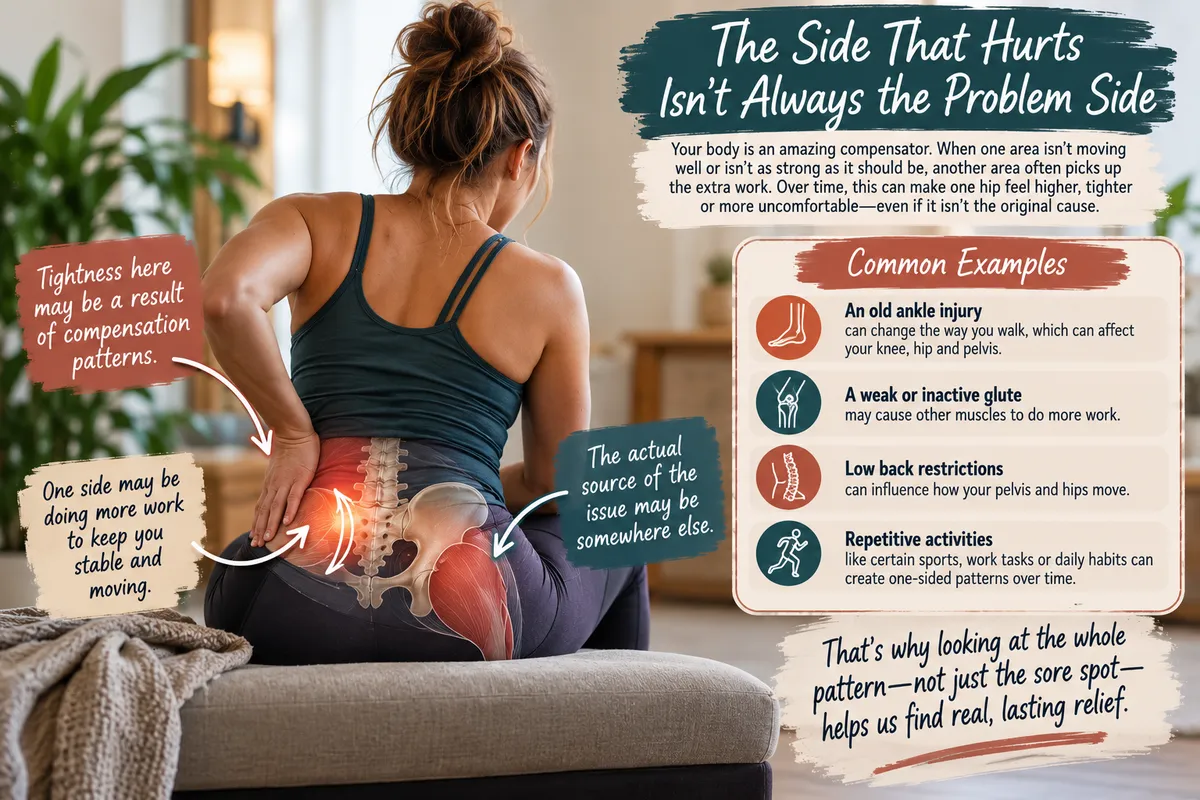
The Side That Hurts Isn't Always the Side Creating the Problem
This one surprises people.
Let's say your right hip constantly feels tight.
Naturally, you attack the right hip.
Stretch it.
Foam roll it.
Massage it.
Stretch it again.
Threaten it.
Google it at 2 a.m.
Stretch it one more time because apparently the first 47 times weren't enough.
😂
But what if that side is tight because it's doing more work?
What if it's helping stabilize something?
What if you're consistently shifting your weight toward that side?
What if the way you move through your ankle, knee, opposite hip or low back is changing what you're asking that hip to do?
The place complaining the loudest deserves attention.
It just doesn't automatically get to take credit for starting the argument.
Tight Doesn't Always Mean "Needs to Be Stretched"
This is another big one.
When something feels tight, our first instinct is usually:
Stretch it.
Sometimes that's exactly what feels good.
But a muscle can also feel tight when it's working hard, guarding, responding to irritation, or trying to provide stability.
That's why endlessly stretching the same area without asking why it keeps becoming tight may give you temporary relief without changing much long-term.
Your body isn't being stubborn.
It's responding to the demands being placed on it.
So... Is My Pelvis "Out of Alignment"?
I don't love that phrase.
It makes it sound like your pelvis is a dresser drawer that jumped off its track and needs somebody to slam it back into place.
Human bodies are more complicated than that.
Pelvic position changes as we move. Bodies have natural asymmetries. Structural leg-length differences can exist, and functional differences in how someone stands or moves can exist as well. Research also shows that simply finding pelvic asymmetry doesn't automatically prove that it is the cause of someone's pain.
Instead of asking:
"How do we put this hip back where it belongs?"
I think a much better question is:
"Why does your body keep choosing this position?"
Now we have something useful to investigate.
Where Corrective Massage Fits In
Corrective massage isn't about looking at you for thirty seconds, declaring one hip "out," and forcing your body into some imaginary perfect position.
At Phoenix Body & Mind, I'm much more interested in the bigger picture.
Where are you feeling discomfort?
How are you moving?
Where are you restricted?
What's doing too much work?
What happens when we change the position or movement?
What does your daily life look like?
What injuries have you had?
And most importantly:
What is your body actually telling us?
Hands-on work may help decrease muscular tension, improve comfortable movement and give an overloaded area a chance to settle down.
But sometimes what I find also tells me that massage isn't the whole answer.
You may benefit from strengthening.
You may need physical therapy.
A true leg-length discrepancy may need proper medical assessment rather than somebody eyeballing your ankles on a massage table.
And sometimes symptoms need to be evaluated by a physician.
Knowing when not to massage something is part of doing this work responsibly.
When It's More Than a Tight Hip
An uneven feeling by itself isn't usually a reason to panic.
But new or worsening symptoms—particularly after trauma—or significant weakness, progressive numbness, or difficulty walking deserve medical evaluation.
And certain symptoms involving the low back require urgent care.
New loss of bladder or bowel control, difficulty urinating, significant weakness in both legs, or numbness around the groin, genitals or buttocks can be signs of serious nerve compression and should be evaluated immediately. Cleveland Clinic explains these warning signs here.
Your Body Isn't Crooked. It's Adaptable.
If one hip feels higher than the other, you don't need to immediately decide something is wrong with you.
Your body has spent your entire life adapting to what you've asked it to do.
Your work.
Your injuries.
Your habits.
Your hobbies.
The way you sit.
The way you stand.
The way you move.
Sometimes those adaptations work beautifully.
Sometimes they eventually start getting your attention.
And that's when it's worth listening.
Because at Phoenix Body & Mind, we're not interested in chasing one sore muscle or telling you that your body is broken.
We want to understand the pattern.
The body doesn't lie—but we can teach it a new truth.
Is One Side of Your Body Always Complaining?
If you're dealing with recurring hip tension, one-sided low-back discomfort, or that stubborn spot that keeps coming back no matter how much you stretch it, it may be time to look beyond the sore spot.
Book a corrective massage at Phoenix Body & Mind and let's take a closer look at what your body has been trying to tell you.
This article is for educational purposes and isn't intended to diagnose or treat a medical condition. Persistent, severe, unexplained or worsening symptoms should be evaluated by an appropriate healthcare provider.
